|
|
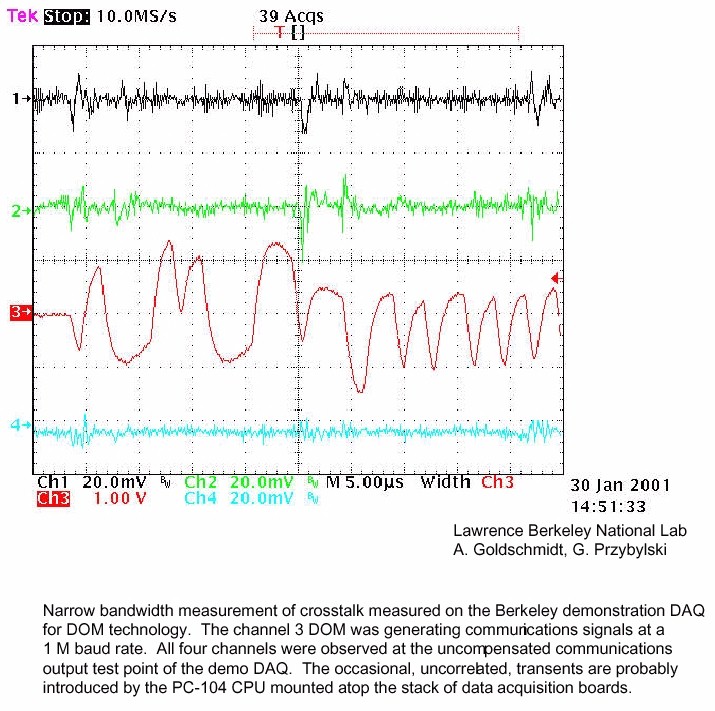
Note the channel 3 waveform 2.8 divisions from the left. Negative modulation does not reach the ADC baseline. Without signal processing to compensate for cable dispersion, information would be lost. The signal to noise ratio of this signal is much better than 15 dB, so full data recovery could be achieved at 1 megabaud if signal processing were improved. (12.5 dB S/N is required for an error rate of one part in 10-5.) |
The cross talk of signals in the pairs of the same quad is comparable to the noise of the oscilloscope, setting a conservative limit of 60 dB S/N ratio. The spikes apparent on channel 1, 2, and 4 appeared to correlate with activity on the PC-104 CPU board inside the enclosure, adjacent to the testboards.
A bi-directional 38 kilobaud ASCII data stream was chosen as the basic, fall back, technology for communicating with the DOMs. High speed communications was not developed at the time the DOMs were deployed. The CPU in the DOM contained a UART which could be programmed for that data rate.
The 38 kilobaud communications signal is not encoded on the twisted pair as ASCII levels because the bandwidth of the system does not extend to zero Hz (or at least a sufficiently low frequency to avoid sag. The low limit on the bandwidth is set by limitations of transformers and by power supply decoupling components. Instead, rising edges of the ASCII signal were encoded as abrupt increases in the voltages on the pairs, followed by abrupt decreases in the voltage on the pair, followed by a return to an unmodulated condition. The black trace (channel 1) in the figure below contains an example of the rising edge modulation. The falling edge modulation first subtracts a voltage, then adds a voltage and returns to the unmodulated voltage level.
For IceCube, the splitting of the power and signals to two DOMs introduces complications explored elsewhere.