|
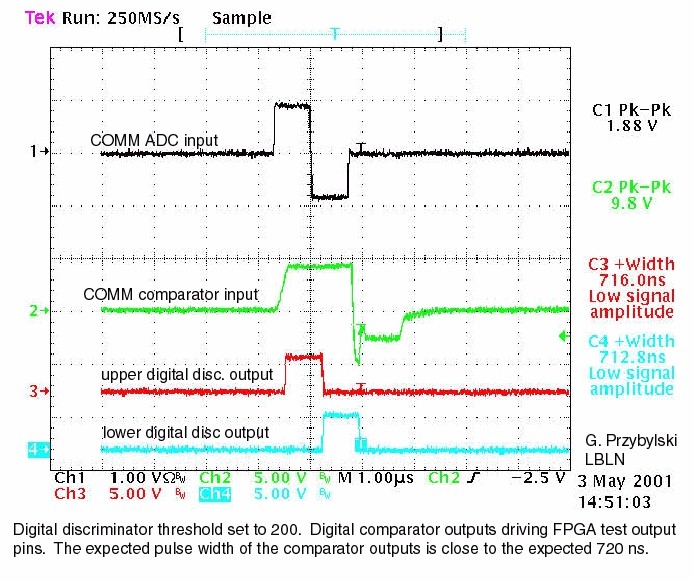
The data transmitter DAC couples its signal to the receiver ADC and through a non-linear amplifier to an analog window comparator. (The circuits were not designed for duplex operation) The level of transmit ADC is sufficient to overdrive the shaping amplifier. The flat topping of the green trace is indicative of saturation or clipping in the amplifier stage. The stretching causes some problems decoding signals at high speeds. The digital comparators see an undistorted signal. |
The communications waveforms must, of course, be converted back to digital signals. The testboards and the DOMs contain hardware for two kinds of signal acquisition. Two comparators create a window around the baseline communications waveform. Positive and negative excursions outside the window produce comparator outputs which must be properly decoded to recover the information content. The typical communications input can be compared with the transmitted output as seen by the local communications input.